The Strategic Thesis: "The Convergence Myth"
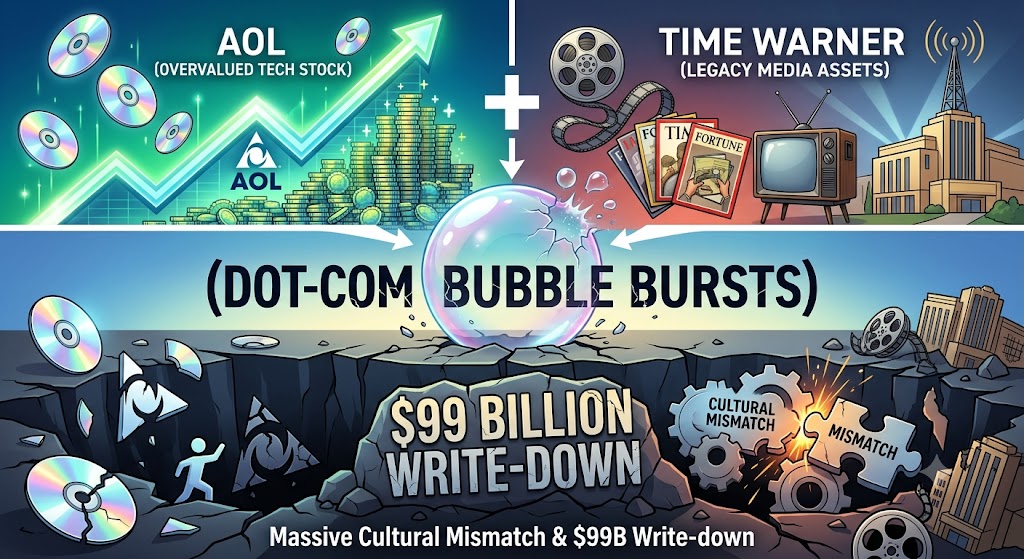
At the turn of the millennium, "convergence" was the ultimate corporate buzzword. The thesis behind the AOL-Time Warner merger was simple on paper: combine the world's dominant internet service provider (AOL) with the world’s premier content and media empire (Time Warner, which owned HBO, Warner Bros., CNN, and Time Inc.).
AOL would provide the digital pipeline and subscription model; Time Warner would provide the premium content to feed that pipeline. It was billed as the creation of a bulletproof internet-age titan.
The Financial Breakdown
Deal Value: $165 billion (originally valued at $182 billion including assumed debt).
The Equity Split: Despite Time Warner having vastly more physical assets, revenue, and cash flow, AOL’s hyper-inflated stock value allowed its shareholders to own 55% of the combined company.
The Fallout: In 2002, the company reported a staggering historic loss of $99 billion due to a massive goodwill write-down as the dot-com bubble burst.
The Fatal Flaws: Operational Friction & Macro Shifts
Cultural Warfare: Time Warner was composed of distinct, fiercely independent "fiefdoms" run by traditional media executives who valued prestige and long-term brand building. AOL was an aggressive, fast-talking, sales-driven dot-com startup. The two leadership teams quickly devolved into infighting, with Time Warner executives viewing AOL staff as arrogant amateurs, and AOL viewing Time Warner as slow-moving dinosaurs.
Incentive Misalignment: Because Time Warner divisions operated as profit centers, they resisted giving away their premium content to AOL for free or at a discount, killing the promised "synergies" from day one.
Technological Obsolescence: The deal relied on the assumption that AOL's dial-up internet subscriptions would remain the gatekeeper of the web. Within months of the merger, residential broadband (high-speed cable and DSL) exploded. AOL completely failed to adapt its business model to broadband, rendering its core distribution engine obsolete almost overnight.
Deep Takeaway : Financial engineering and "strategic synergies" cannot fix a toxic culture or a flawed macroeconomic thesis. Never buy an asset using an inflated currency (like bubble-era stock) without stress-testing what happens if the macroeconomic environment shifts 180 degrees.