The Strategic Thesis: "Fixing the Engine"
By 2005, Disney’s core animation business was floundering. Hits like Treasure Planet and Home on the Range underperformed, while their distribution partnership with Steve Jobs’ Pixar Animation Studios was expiring. Pixar was on an unprecedented run of masterpieces (Toy Story, Monsters, Inc., The Incredibles).
Incoming Disney CEO Bob Iger realized a harsh reality: Disney Animation had lost its creative compass. Instead of trying to compete and risk losing Pixar to another distributor, Iger proposed an aggressive, counter-intuitive strategy: buy the partner, but let the partner run the parent.
The Financial Breakdown
Deal Value: $7.4 billion (an all-stock transaction).
The Premium: Disney paid a significant premium, valuing Pixar at roughly $42 per share.
The Structural Twist: Steve Jobs became Disney’s largest individual shareholder (holding about 7% of Disney stock) and joined the Disney Board of Directors.
The Granular Mechanics: The Pixar Governance Agreement
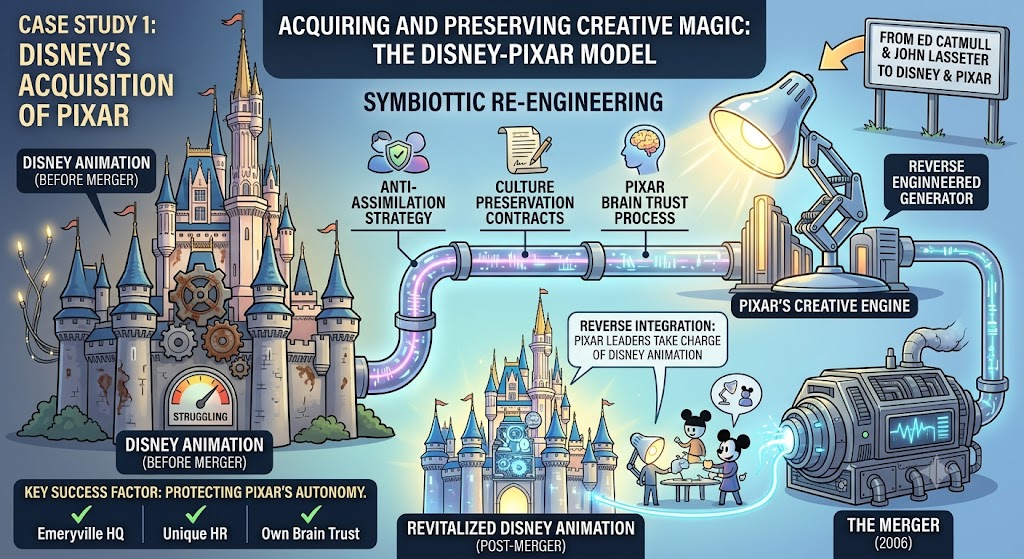
Most M&A failures occur during Post-Merger Integration (PMI) because the buyer forces corporate standardization. To prevent this, Iger and Pixar’s founders (Ed Catmull and John Lasseter) drafted a binding, 21-page Pixar Governance Agreement.
Operational AreaPixar’s Protected AutonomyIdentity & BrandingPixar retained its name, and its distinct sign remained unchanged outside the Emeryville campus. No Disney branding could be forced onto Pixar films.Human ResourcesPixar kept its unique bonus structure, employment contracts, and human resource policies completely separate from Burbank corporate.The "Brain Trust"Pixar’s peer-to-peer review system remained strictly internal. Disney executives were barred from giving mandatory creative notes on Pixar scripts or cuts.Physical IsolationPixar stayed in Emeryville, California—hundreds of miles away from Disney’s corporate headquarters in Burbank, preventing "corporate creep."
The Real Insight: Reverse Integration
Instead of Disney absorbing Pixar, Disney practiced reverse integration. Ed Catmull was named President of both Pixar and Disney Animation Studios, and John Lasseter became Chief Creative Officer of both. They brought Pixar’s transparent, non-hierarchical culture back to Burbank, effectively revitalizing Disney Animation and leading to a second golden age (Tangled, Frozen, Zootopia).
Deep Takeaway: True asset value often resides entirely in human capital and corporate culture. If you strip away the unique environment that created the asset, you are left with an empty shell. In creative or highly technical industries, integration should protect autonomy, not enforce conformity.
References
- Harvard Business School