Introduction: The Siren Song of AI The promise of artificial intelligence is irresistible for modern corporations. From real-time predictive analytics to full-scale operational automation, the perceived efficiency gains are immense. Many leadership teams, eager to capture market share and optimize margins, rush into complex AI implementations with the same hubris that has felled corporate giants before. They assume a powerful algorithm can magically synthesize disparate information, neglecting the single most important factor: the quality of the data it consumes. This case study details the downfall of a mid-size company that paid a heavy price for this assumption, proving that without clean data, AI is not a savior, but a scaled accelerator of failure.
Company Profile: Synergy Solutions Inc. Synergy Solutions was a successful, fast-growing mid-size manufacturer of specialized electronic components. Their logistics and supply chain was their differentiator, known for its speed. In 2024, aiming to maintain their competitive edge against larger rivals, the executive board greenlit a ambitious project: "Operation Quantum Flow." The goal was to build a state-of-the-art machine learning model to predict raw material shortages, optimize inventory, and automate procurement. They budgeted $500,000 for development, hiring a top-tier AI consultancy.
Phase 1: The Initial Promise The project began with optimism. The consultants, focused purely on the algorithm, built sophisticated neural networks. Early proofs-of-concept using small, curated data sets yielded impressive results: inventory forecasting with 95% accuracy and an automated purchasing system that seemed poised to slash costs. Synergy's manager of Operation Quantum Flow was featured in internal newsletters, celebrating the company's forward-thinking innovation. The strategic vision of AI-driven market dominance seemed within reach.
Phase 2: Scaling into Reality – The Fragmented Data Pipe The problems started during the full-scale deployment phase, as the algorithm was connected to the actual corporate data ecosystems. Like many mid-market companies that grew quickly, Synergy had a fragmented IT architecture:
Legacy Inventory Systems (Dating to 2012): Their main raw material database was an older, on-premise system that used a different schema for every localized facility.
Un-integrated CRM: Their client order data lived in a modern, cloud-based CRM that was not natively connected to the inventory system.
Spreadsheet 'Shadow IT': Many localized facilities managed critical, off-system data (e.g., temporary supplier discounts, specific local transport data) via hundreds of decentralized Excel spreadsheets.
Connecting the AI to this mess created what engineers later described as a "Data Mismatch Tsunami." The sophisticated algorithm was suddenly drinking from a fractured, polluted pipe. It was encountering:
Duplicate Entities: "Supplier A" was "SUPA CORP" in the legacy system, "Supplier A" in the CRM, and "SA Co." in multiple spreadsheets. The AI treated these as different companies, making aggregate forecasts impossible.
Inconsistent Data: Critical fields like "delivery time" had different units (days vs. hours) and definitions across systems, making time-to-market predictions wildly inaccurate.
Non-Standardized Data: Critical condition fields for components were binary in one system but use descriptive text ("new" vs. "revised") in others, creating classification nightmares for the model.
Phase 3: The Algorithmic Collapse and True Cost The hubris lay in assuming the model would correct these issues. Instead, it was simply overwhelmed. The algorithm began to exhibit "hallucinations" – making absurdly confident, yet wildly incorrect, supply and pricing predictions based on contaminated data.
Inventory Explosion: Misinterpreting a lack of standardized data as a pattern of shortages, the automated purchasing system ordered massive overstock of expensive, low-demand components. Within a month, localized facilities were bursting at the seams with $1.2 million in unsellable inventory.
Reputational Damage: The system began to output dynamically-generated "optimal" prices that were sometimes hundreds of percentage points above or below market rate, confusing and alienating long-term clients. Sales teams had to manually override the system, creating logistical chaos.
Operational Paralysis: Attempts to fix the system were fruitless without addressing the underlying data, leading to finger-pointing and strategic drift.
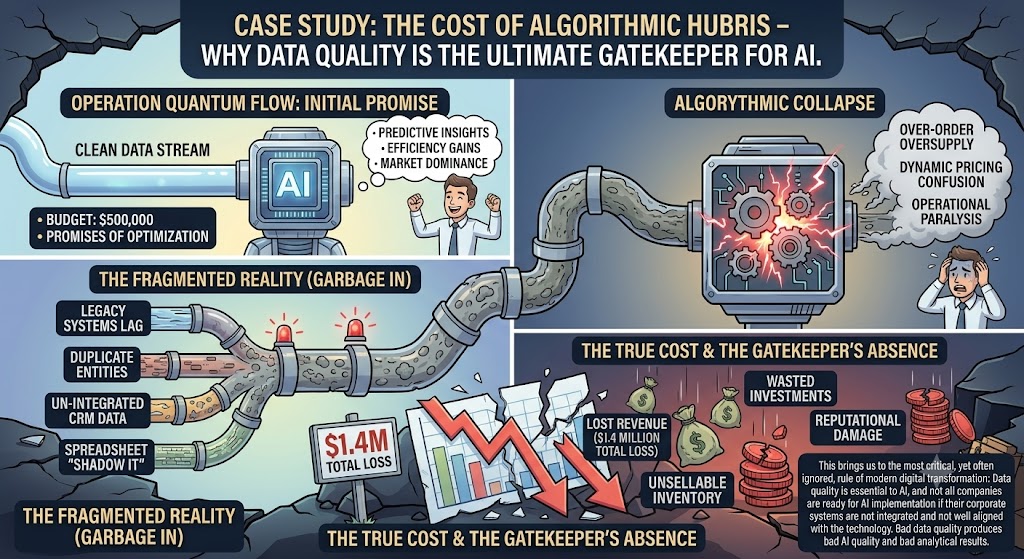
Phase 4: The Fallout and Lessons Learned Just six months after deployment, Synergy Solutions was forced to suspend Operation Quantum Flow. The financial cost was a catastrophic $1.4 million in wasted investments and unsellable inventory.
The ultimate lesson was clear: Data quality is not an engineering line item; it is the strategic gatekeeper. AI is only as smart as the information it is fed. It is not all companies are ready for AI implementation if their corporate systems are not integrated and not well aligned with the technology. Synergy had built a multi-million-dollar AI-driven sports car and filled the fuel tank with a fractured mix of contaminated sludge. Their failure was a failure of data, not mathematics. For mid-size companies looking to RG Enterprise Consulting, the first prerequisite for any AI dream must be information architecture, system integration, and cloud migration. Only then can the true potential of AI be unlocked.
Executive Takeaway: The Data-First Mandate for AI
Before a corporation spends a single dollar on advanced machine learning algorithms, large language models, or predictive analytics, leadership must accept an absolute truth in modern enterprise technology: Information Architecture must always precede Artificial Intelligence.
The Golden Rule of AI Readiness
AI is not a magic cleaning solution for messy operational legacy infrastructure. It is a highly scaled amplifier. If you feed it clean, unified, cloud-integrated data, it accelerates your growth. If you feed it fragmented data, duplicate records, and decentralized "shadow IT" spreadsheets, it accelerates your financial exposure. Bad data quality produces bad AI quality and disastrous analytical results.
The 3 Core Pillars of Data Readiness
To ensure your corporate systems are fully aligned with modern technology before an AI rollout, cross-functional teams must audit three specific areas:
System Integration: Dismantle on-premise silos. Your ERP, CRM, and financial ledgers must communicate via a unified, real-time cloud data pipeline to prevent blindspots.
Master Data Management (MDM): Establish strict governance protocols. A single customer, supplier, or SKU must have identical definitions, naming conventions, and data fields across every single department.
Automation of Data Validation: Implement automated data-cleansing gates. Corrupted or unvetted data must be flagged and isolated at the ingestion layer before it travels downstream and contaminates your machine learning models.
How RG Enterprise Consulting Bridges the Gap
Many consulting firms will happily sell you a highly complex AI model without looking under the hood of your existing IT infrastructure. At RG Enterprise Consulting, we take a PMO-driven, engineering approach to digital transformation.
We protect your technology investment by executing a rigorous data readiness roadmap first. We help mid-market corporations audit their legacy systems, navigate secure cloud migrations, eliminate operational silos, and establish ironclad data governance frameworks. We ensure your data foundation is pristine, stable, and architecturally sound—so that when you deploy AI, it yields the trustworthy, high-impact business intelligence your organization needs to dominate the market.