Most integration plans assume the deal you signed is the deal you will run. In April 2019, Waste Management agreed to acquire Advanced Disposal Services for $4.6 billion in enterprise value, adding roughly three million commercial, industrial, and residential customers across sixteen eastern U.S. states. The agreement capped anticipated regulatory divestitures at $200 million in revenue — a manageable, well-understood cost of doing the deal. Eighteen months later, when the acquisition finally closed, the U.S. Department of Justice had required Waste Management to divest $863.5 million in assets across ten states: fifteen landfills, thirty-seven transfer stations, twenty-nine hauling facilities, and more than two hundred collection routes. The final divestiture package was 4.3 times larger than the perimeter the integration team had originally planned around.
That is the part of this deal most case studies skip. The headline is the price tag. The lesson is what happened to the people running the integration while the ground kept shifting under them.
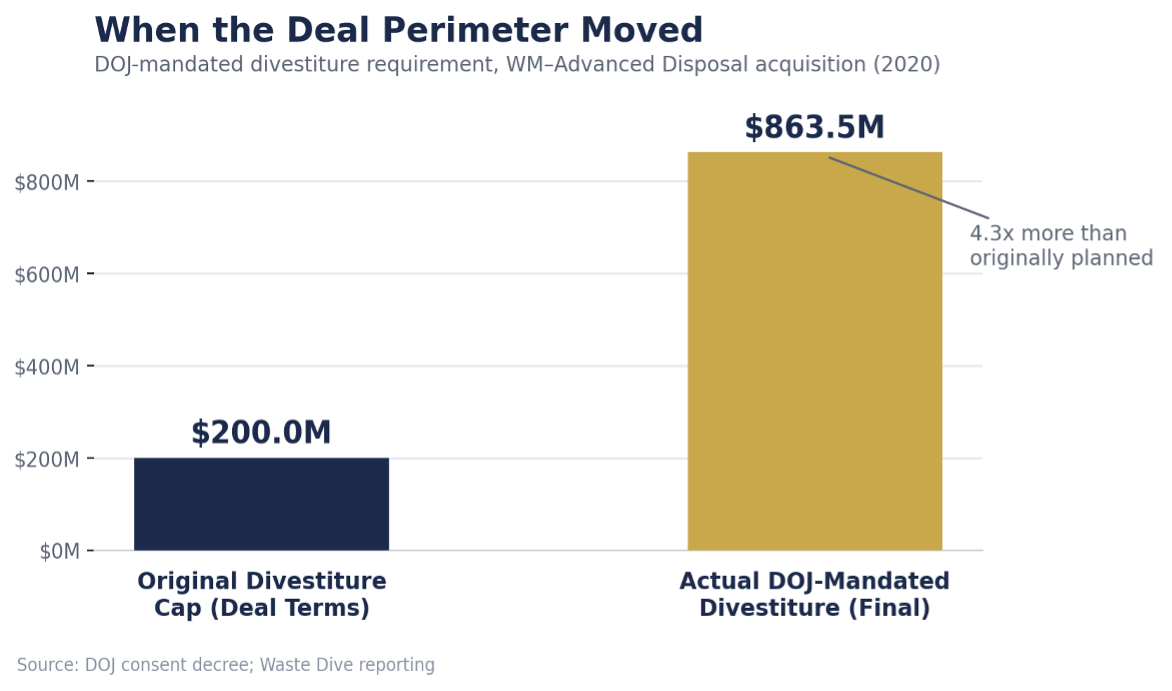
Source: DOJ consent decree; WasteDive reporting
The Problem With Planning Around a Fixed Perimeter
Every post-merger integration plan starts with an assumption: here is what we bought, here is what we are combining, here is the operating model we are building toward. Waste Management's team built exactly that kind of plan in 2019. Then COVID-19 hit Advanced Disposal's revenue mid-review, state attorneys general in Illinois and Wisconsin pushed for adjustments, and the DOJ's competitive concerns proved far more extensive than the deal's own divestiture cap anticipated. GFL Environmental, a Canadian waste company with the balance sheet and the limited existing U.S. footprint regulators wanted, ended up acquiring nearly a quarter of the assets Waste Management thought it was buying — before Waste Management ever finished integrating the rest.
In practice, that meant the IMO was running two conflicting programs at once: integrating the operations it was keeping, while simultaneously packaging up and transferring a moving set of assets to a third party, under a timeline that kept extending. Route consolidation plans had to be redrawn as facilities were pulled out of scope. Customer communications had to account for accounts that might not stay Waste Management accounts. None of this was in the original 100-day plan, because none of it was knowable when the plan was written.
Despite that, CEO Jim Fish told investors on close that the integration teams had “prepared us to provide a seamless transition for employees and customers.” That claim was tested in public, in real time, against a moving target — and the company still delivered against a synergy commitment of more than $100 million in annual cost and capital expenditure savings.
What the Research Says About Why This Matters
The instinct in most PMI programs is to treat the deal perimeter as fixed and the integration plan as the variable that adapts to reality. Waste Management's experience argues for building the plan to survive a moving perimeter from day one — and the research on how synergy capture actually gets rewarded backs this up. BCG's 2025 analysis of 175 large acquisitions between 2019 and 2023 found that acquirers who disclosed their actual synergy realization progress to investors — not just their targets — achieved roughly 6% higher relative total shareholder return over the following two years than acquirers who stayed quiet. Transparency about tracking, in other words, is not just good governance. It is a measurable value driver, and it is only possible if the integration team has built a plan disciplined enough to keep measuring progress even when the thing being measured keeps changing shape.
What a Resilient Integration Plan Actually Does Differently
Three practices separate an integration plan that survives a moving perimeter from one that stalls.
It separates the synergy commitment from the integration milestone plan. Waste Management could still credibly report progress toward its $100 million target because that number was never tied to a single fixed set of facilities — it was tied to the operating model for whatever the company ended up owning. Programs that hard-wire savings targets to specific assets lose credibility the moment those assets change hands.
It runs a genuine carve-out discipline even when you are the buyer, not the seller. Waste Management's team had to execute a clean divestiture to GFL — data separation, transition service arrangements, employee transfers — as a parallel workstream to its own integration. That is precisely the muscle that mid-market acquirers running serial add-on strategies need, because the next deal is rarely as clean as the first one looked on signing day.
It treats “seamless transition” as an integration deliverable, not a communications line. Fish's promise to employees and customers only held up because the IMO had built the operational capacity to make it true — route continuity, billing continuity, a single point of contact — while the deal's legal and financial perimeter was still being renegotiated around them.
Why This Matters for a Mid-Market Deal, Not Just a $4.6 Billion One
Few RGE clients will run a divestiture the size of Waste Management's. But the underlying condition — signing a deal whose final scope, terms, or timeline shift materially between agreement and close — is now closer to the norm than the exception, particularly as antitrust scrutiny extends further down into mid-market transactions and PE-backed roll-ups face more coordinated regulatory attention than they did five years ago. An integration management office built around a single, fixed assumption about what the company will look like on day one is an IMO built for the deal you wish you had, not the one you are actually going to close.
The firms that come through these situations well are the ones that build flexibility into the governance layer before they need it: synergy tracking that survives a changing perimeter, a carve-out playbook ready to run in parallel with the main integration, and a communications commitment the operating team can actually deliver on. That is Day-1 readiness in the truest sense — not readiness for the deal as signed, but readiness for the deal as it will actually close.
RG Enterprise Consulting leads Integration Management Office design, Day-1 and Day-100 readiness planning, and synergy realization tracking for M&A and PE-backed transactions across North America and Latin America. If your next deal's perimeter is still moving, we would welcome a conversation. Schedule a call at rgenterpriseconsulting.com/contact.
References
- Waste Management, investor press release, June 2020 (investors.wm.com). WasteDive, “Waste Management completes $4.6B acquisition of Advanced Disposal, following regulatory approval.” Waste360, “WM + Advanced Disposal: A Closer Look at the New Deal.” Boston Consulting Group, “Capturing Value from Synergy in PMI: Four Essential Steps,” 2025.